

Excursions
Hue City (Chan May Port) Highlight Tour (Trip# 848108)
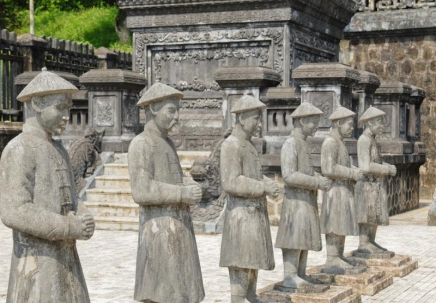


Hue City (Chan May Port) Highlight Tour (Trip# 848108)
(Vietnam)- If art and architecture matter more to you than beaches and beer, Hue will be high on your vietnam must- visit list. The capital of the Nguyen emperors, Hue is packed with temples, tombs, palaces and pagodas or at least the remains of those that successive armies didn't manage to completely destroy. Foodies won't want to miss the fussy degustation-style Imperial cuisine for which this city is rightly famous.
- In 1993 Unesco designated the complex of monuments in Hue a World Heritage site, and restoration and preservation work continues.
- This trip includes:
- Round trip transportation from the cruise port
- English-speaking private guide/driver for 10 hours
- Admission tickets
- This trip excludes:
- Meals & Tips
TOUR DETAIL
Itinerary (8:00 to 4:00):
Cruise Terminal Pick Up >> Hue Citadel >> Imperial Enclosure >> Nog Mon Gate >> Thai Hoa Palace >> Halls of the Mandarins >> Forbidden Purple City >> Return to Cruise Terminal
Point of interest:
**Hue Citadel - Most of Hue's sights and a sizeable chunk of its population reside within the 2m- thick, 10km-long walls of its Citadel on the north bank of the river. Begun in 1804 on a site chosen by Emperor Gia Long's geomancers, it was originally made of earth and later strengthened with brick.
Roughly square shaped, three sides of the Citadel are straight; the fourth is rounded slightly to follow the curve of the river. The ramparts are encircled by a zigzag moat, which is 30m across and about 4m deep. There are 10 fortified gated, each accessed via a bridge. In the northern corner of the Citadel is Mang Ca Fortress, which is still used as a military base.
At the centre of the wall facing the river, the 37-m high Flag Tower is Vietnam's tallest flagpole. Erected in 1809 and extended in 1831, it was knocked down in 1904 by a typhoon that devastated the city. It was rebuilt in 1915 only to be destroyed again in 1947. Two years later it was erected once, in its present form. During the VC occupation in 1968, the National Liberation Front flag flew defiantly from the tower for 3 1/2 weeks.
Located just inside the Citadel ramparts, near the gates to either side of the Flag Tower, the Nine Holy Cannons, symbolic protectors of the palace and kingdom, were cast in 1804 from brass captured from the Tay Son Rebels. Commissioned by Emperor Gia Long, they were never intended to be fired. Each is 5m long, has a bore of 23m and weighs about 10 tonnes. The four cannons near Ngan Gate represent the four seasons, while the five cannons next to Quang Duc Gate represent the five elements: metal, wood, water, fire and earth.
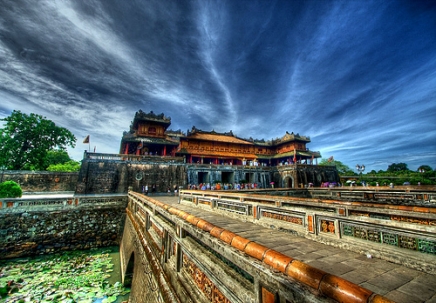
**Imperial Enclosure - Housing the emperor's residence and the main buildings of state, the Imperial Enclosure is a citadel- within-a- citadel, with 6m-high walls that re 2.5km in length. The enclosure was badly bombed during the France and American Wars, and a large part of it is still park-like ruins. Restoration of the least damaged sections and the complete rebuilding of others is an ongoing project.
This is a fascinating site, which you could easily spend the better part of a day exploring. It's completely iniquitous that most day tours include a only brief stop here-it is easily reached on foot from anywhere in Hue and much more enjoyable as a leisurely stroll.
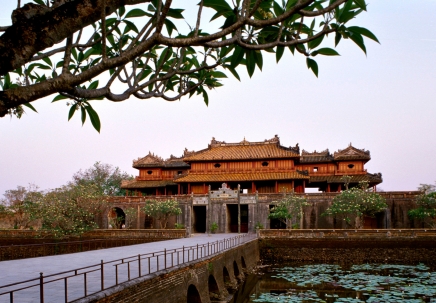
**Nog Mon Gate - The principal entrance to the Imperial Enclosure is Nog Mon Gate, which faces the Flag Tower. The central passageway with its yellow doors was reserved for the use of the emperor, as was the bridge across the lotus pond. Other mere mortals had to use the gates to either side and the paths around the pond.
On top of the gate is Ngu Phung, where the emperor appeared on important occasions, most notably for the promulgation of the lunar calendar. On 30, August 1945 the Nguyen dynasty ended here when Emperor Bao Dai abdicated to a delegation sent by Ho Chi Minh's Provisional Revolutionary Government.
**Thai Hoa Palace - Built in 1803, Thai Hoa Palace is a spacious hall with an ornate timber roof supported by 80 carved and lacquered columns. It was used for the Emperor's official receptions and other important court ceremonies, such as anniversaries and coronations. During state occasions the emperor sat on his elevated throne and his mandarins paid homage. Nine stelae divide the two-level courtyard into separate areas for officials in each of the nine ranks of the mandarinate; administrative mandarins stood to one side while the military mandarins stood to the other.
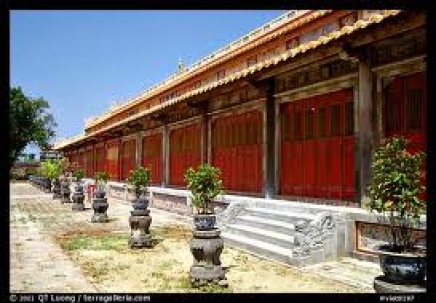
**Halls of the Mandarins - The buildings in which the mandarins prepared for court ceremonies were restored in 1977. The structures are located directly behind Thai Hoa Palace on either side of a courtyard, where there are two gargantuan bronze vac dong dating from the 17th century. The hall to the left has been set up for cheesy tourist photos; you can pose in Imperial costume on the throne for 20,000d, while two flunkies will pose with you for 40,000d. The opposite hall houses a collection of gowns and porcelain from the Nguyen era. Behind the courtyard are the ruins of the Can Chanh Palace, a large hall for receptions.
**Forbidden Purple City - Behind the palace, in the very centre of the Imperial Enclosure, the Forbidden Purple City is a citadel- within- a-citadel-within-a-citadel. Reserved solely for the personal use of the emperor, the only servants allowed into this compound were eunuchs who would pose no thread to the royal concubines. It was almost entirely destroyed in the wars, and a large part is now draped in green foliage. Take care as you wander around the ruins as there are some gaping holes.